Showing posts with label Linux. Show all posts

Wednesday, August 20, 2008

Virtual Volumes View

Free indexing app Virtual Volumes View (VVV) helps you keep track of exactly which file is located on which of those numbered DVDs. Once you've let VVV take a look at each of your discs, it can show you them in a physical view (each disc and its contents), a virtual view (one giant file system), or let you simply search through files

vvvv-win

vvv-lin

Wednesday, August 6, 2008

Ant Movie Catalog

Ant Movie Catalog is a free (really free, i.e. the source code is available) program made to manage your collection of movies on DVD, CD (VideoCD, DivX, ...) and tapes.
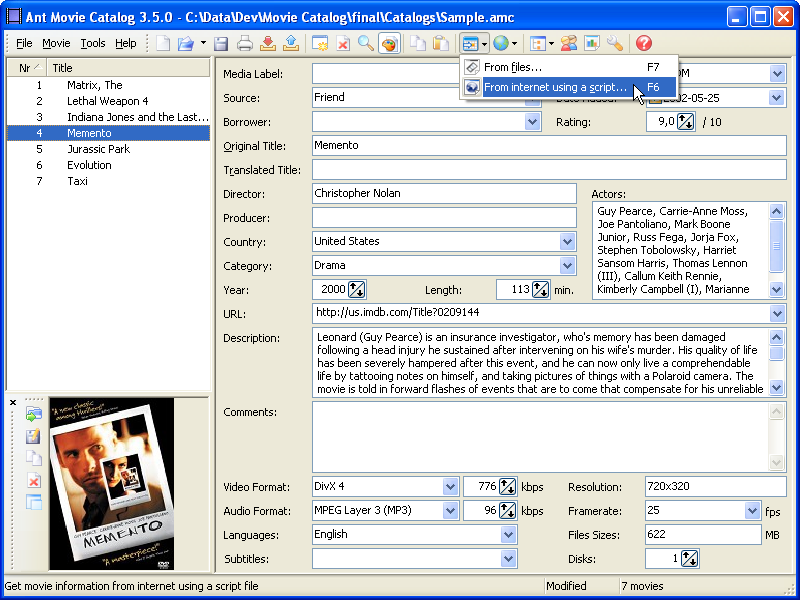
AMC

If you use GNU/Linux rather than Windows, you can try to use WinE to get this program running; some people notified me that this was working. You can also check Moviefly, which is a complete rewrite of Ant Movie Catalog made with Python.

Moviefly stores information on video media files, including title, actors, genre, descriptions, comments, rating, director, producer, picture, languages, subtitles, video- and audio format, video- and audio bitrates, resolution, framerate, file size and media type. Technical information can be automatically extracted, descriptive information on a title may be downloaded from the internet.

Moviefly

Thursday, June 19, 2008

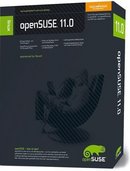
openSUSE 10.3 released

Features added to OpenSuse 11.0 since version 10.3, the latest stable version, include Linux kernel 2.6.25, Xen 3.2 virtualisation, windowing engine X.Org 7.3.openSUSE 11.0 includes two branches of KDE — the KDE 3.5.x series, which is the stable and older KDE series that many openSUSE users are already familiar with, and the cutting edge KDE4. GNOME users will find a lot to like in openSUSE 11.0. openSUSE’s GNOME is very close to upstream GNOME, because Novell and openSUSE want to do as much work as possible in the upstream release. OpenOffice.org 2.4 provides openSUSE users with a top-notch office suite with a word processor (Writer), spreadsheet (Calc), presentation tool (Impress), and drawing software (Draw). Here’s some of the improvements you’ll see in openSUSE 11.0:

  • Rewritten installer that makes installation even easier

  • Faster and easier package management

  • Easier system updates with PackageKit

  • Easier 3-D effects with Compi z-Fusion and CCSM

  • KDE 4 - The next generation KDE Desktop

  • GNOME 2.22 - Latest and greatest GNOME release

  • Firefox 3.0 - openSUSE ships with Firefox 3.0 beta 5, will update to 3.0 final

  • OpenOffice.org 2.4 - Latest OpenOffice.org, with dozens of improvments and new features, including better VBA support, 3-D transitions in Impress, and import support for Microsoft Office 2007 document formats.

  • Banshee 1.0 - Major update to Novell-sponsored multimedia application.

  • Tasque - Simple and elegant to-do application.

  • NetworkManager 0.7 - Cutting edge release of NetworkManager, which includes support for EV-DO/UMTS cards.

  • PulseAudio - Better sound management in GNOME.

  • Linux kernel 2.6.25 - Most recent major release of the Linux kernel

  • Nearly every application has been updated since 10.3

  • More than 200 new features specific to openSUSE

Wednesday, June 18, 2008

CherrPal

Upstart CherryPal announcing that it's about to bust out a cloud computer that'll consume 2 watts of power. CherryPal uses for Freescale's new 400MHz MPC5121e.mobileGT processor. The MPC5121e processor is built on Power Architecture technology. Manufactured on Freescale's 90-nanometer low-power CMOS technology, the MPC5121e device is designed to deliver exceptional multimedia performance. The processor is built around an efficient triple-core architecture consisting of a Power Architecture core, a 3D-graphics processor core, and a CD-quality audio processor core.

Specification:

  • 256 MB DDR

  • 4GB internal NAND flash memory

  • 50GB online

  • 802.11b/g WiFi

  • Ethernet

  • 2 USB

  • 32-bit Truecolor display, 720p (1280×720) and WXGA (1366×768)

  • 1.3 x 4 x 6 inches (size of a paperback), 10 ounces


cherrpal.jpg

Thursday, June 5, 2008

Google Gadgets for Linux

Google Desktop is a desktop search application that runs on Windows, Mac, and Linux. But the Linux version has always been a bit behind the curve. While all three clients let you search the web or files on your computer, the Mac and Windows versions have long supported Google Gadgets, which are desktop widgets that let you do everything from checking the weather to controlling your media player software.

Now Google has released an update that brings gadgets to Google Desktop for Linux.

ggl

Wednesday, June 4, 2008

AcetoneISO 2.0

AcetoneISO 2.0, a free, open-source application for Linux systems, gives you complete control over your disk images and CD/DVD mounting without having to touch the command line once.

AcetoneISO2

Friday, May 16, 2008

Adobe Flash Player 10 Beta for Linux

Adobe® Flash® Player 10, code-named “Astro,” introduces new expressive features and visual performance improvements. This public prerelease is an opportunity for developers and consumers to test and provide early feedback to Adobe on new features, enhancements, and compatibility with previously authored content. Once you’ve installed Flash Player 10 beta, you can view interactive demos.

Tuesday, May 13, 2008

Alliance - Private P2P File-Sharing Networks

Alliance, a free, open-source, cross-platform peer-to-peer application, takes nearly all of the security and privacy concerns out of peer-to-peer file sharing by putting you in charge of your own network. The dead-simple interface lets you add Alliance-using friends to your network and files on your system to share, and you can search, chat, and download like any other peer-to-peer app. The traffic between clients is encrypted at a low level, but you can apply an experimental SSL layer.

Alliance

Linux Filesystem Hierarchy

Cool and beautiful representation of the hierarchy which I found linuxconfig.org site.

Linux FS Hierarchy

VirtualBox

Sun xVM VirtualBox is an X86 virtualization software package originally developed by German software company Innotek GmbH, now a product of Sun’s xVM family, suitable for both enterprise as well as home use. Not only is VirtualBox an extremely feature rich, high performance product for enterprise customers, it is also the only professional solution that is freely available as Open Source Software under the terms of the GNU Public License (GPL).

VirtualBox

FlickrFS

Flickrfs makes uploading to, downloading from, and organizing a Flickr account just like handling files in a mounted file system. After installing and setting up the link to your account, you can see all your photos separated into tag folders, edit and back up the pics and their metadata, and crop and resize photos on the fly, all reflected in realtime in your online account.

FlickrFS

Wednesday, March 19, 2008

EclipseXSLT - XSLT Support for Eclipse

I kept searching for XPath tool and found really nice Eclipse plugin called EclipseXSLT.


EclipseXSLT

I also found the other one, XPath Plugin, but it seem to be very limited in comparison to first one.

Friday, March 14, 2008

Skype 2.0 for Linux released

Skype has released the final version of Skype 2.0 for Linux. The internet telephony application has been available as a public beta since November, but the latest release includes a ton of bug fixes and a few new features.

Skype4Linux

transKode Script

Convert audio files from inside your favorite music/playlist manager with transKode, a free plug-in for Amarok. If you've never installed an Amarok script, it's simple—grab the package ending in .tar.bz from the link below, head to the Tools->Script Manager menu, then hit the "Install" button and point to where you put that package.

transKode

Wednesday, March 12, 2008

openSUSE Forums

In order to provide a better service to the existing openSUSE Community and to our new users, we’re pleased to announce that suseforums.net, suselinuxsupport.de and the openSUSE support forums at forums.novell.com (the three largest English speaking dedicated SUSE forums) are joining forces to merge into the new official openSUSE Forums at forums.opensuse.org.


openSUSE
SUSE Forums
SUSE Linux Support

Friday, February 29, 2008

ISO Master

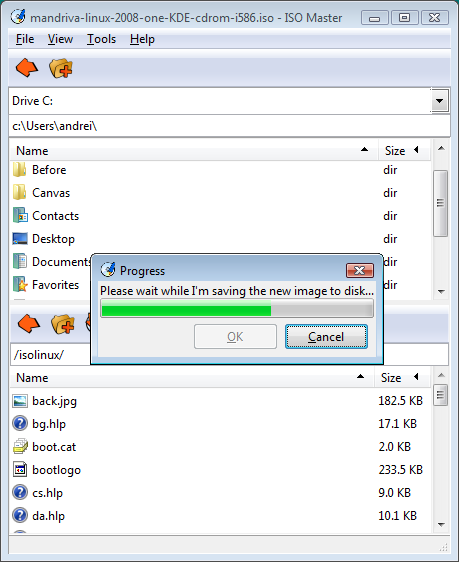
ISO Master is an open source graphical (GUI) application for Linux which enables users to create and modify ISO9660 files; ISO images and NRG (Nero) images. It allows you to create an ISO from scratch, add or remove files and directories from or to a CD image and also create bootable CDs using various record types. The Linux version is free, but the Windows version is not. Download.

ISOMaster

Friday, February 22, 2008

TestDisk

TestDisk is a powerful free data recovery software! It was primarily designed to help recover lost partitions and/or make non-booting disks bootable again when these symptoms are caused by faulty software, certain types of viruses or human error (such as accidentally deleting a Partition Table). Partition table recovery using TestDisk is really easy. Download.

TestDisk

Monday, January 28, 2008

Nokia to Acquire Trolltech

Nokia and Trolltech just announced that they have entered into an agreement that Nokia will make a public voluntary tender offer to acquire Trolltech. The latter is a recognized software provider with world-class software development platforms and frameworks. In addition to the key software assets, its team will play an important role in accelerating the implementation of Nokia’s software strategy.

NokiaQt

Friday, January 25, 2008

FlyBack: A “Time Machine” Backup for Linux Desktops

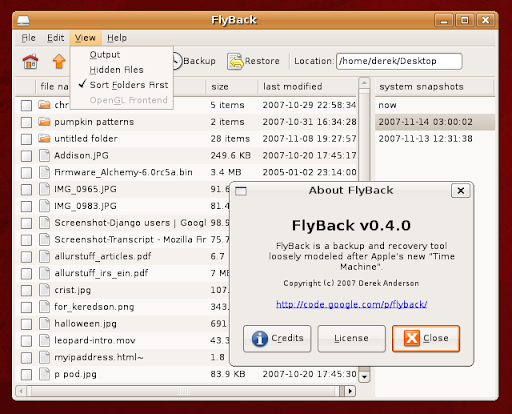
Flyback, the project has been working on developing an rsync-based GUI solution for Linux with Time Machine as the model. FlyBack is a snapshot-based backup tool based on rsync It creates successive backup directories mirroring the files you wish to backup. FlyBack creates incremental backups of files which can be restored at a later date. It also supports limited restoration of files within applications that are specifically programmed to use Time Machine’s functionality.

Flyback

Monday, January 21, 2008

Linux: Misplace a file? Find it quick!

In Linux, there are three main search commands: find, locate and whereis. Each is a little different in terms of how and what they search. So when it is appropriate to use one over the others?

Terminal